

What Are My Rights if My Neighbour’s Tree Branches Hang Over My Fence in NSW?
A Lopping Tree job may seem like the quick answer when branches cross your fence,
but in NSW you should first speak with your neighbour, check your local council’s tree rules and
avoid cutting in a way that damages a protected tree.
The quick answer
In NSW, you may generally be able to cut branches that extend onto your land back to the
property boundary. However, that does not give you an unlimited right to cut.
Before trimming overhanging branches, talk to your neighbour and check with your local council.
A tree preservation order, heritage control, significant-tree rule or vegetation protection
control may require approval. You must also avoid entering the adjoining property without
consent and should not prune so heavily that the tree is damaged, destabilised or killed.
Where the tree has caused property damage, is likely to cause damage in the near future or
presents a risk of personal injury, an affected landowner may be able to seek orders through
the NSW Land and Environment Court under the
Trees (Disputes Between Neighbours) Act 2006.
| Situation | Practical starting point |
|---|---|
| Small branches crossing your fence | Speak to the neighbour and check council pruning rules before cutting. |
| Protected, heritage or significant tree | Do not prune until the relevant council requirements are confirmed. |
| Large or heavy limb over a roof | Keep people away and arrange a professional tree risk assessment. |
| Branches touching powerlines | Do not approach or cut them yourself. Treat the situation as an electrical hazard. |
| Damage has occurred or is likely soon | Document it, obtain expert evidence and consider legal advice or a Trees Act application. |
Your rights when a neighbour’s tree hangs over your NSW property
The issue is often described as the common law right of abatement. In simple terms, abatement
means taking reasonable action on your own land to stop an encroachment. For tree branches, this
may permit boundary tree pruning back to the property line.
But the word “reasonable” matters. The fact that a branch crosses your fence does not normally
let you enter the neighbour’s yard, climb their tree, cut beyond the boundary or remove so much
growth that the tree becomes unsafe.
Your rights also sit beside local council tree rules in NSW. A protected tree register,
development control plan, local environmental plan, heritage listing or biodiversity restriction
may limit what can be pruned. Legal Aid NSW therefore recommends speaking with the neighbour and
checking council requirements before cutting.
Unauthorised pruning can lead to enforcement action even when the branch was above your yard.
Can I cut my neighbour’s tree branches back to the property boundary?
You may usually be able to trim growth that has crossed onto your property, but the cut should
normally stop at the boundary line. You should not reach across the fence and cut a branch closer
to the trunk merely because it makes the job easier.
A boundary cut can still be unsafe. A thick lateral limb may be carrying a large amount of weight.
Cutting it at the fence could tear bark, leave an oversized wound or change the balance of the
canopy. This is one reason professional tree trimming is different from simply cutting wherever
the branch crosses the fence.
Neighbour’s land
Your land
Do not assume this is a safe cut point
For a large branch, an arborist may recommend a staged reduction or a proper pruning cut at a
suitable lateral branch. That work may require the tree owner’s agreement because the correct cut
could be on the neighbour’s side of the boundary.
Read more about the difference between
tree lopping, tree pruning and tree trimming in Sydney
.
Do I need council approval before lopping trees over my fence?
Possibly. There is no single approval rule that applies to every Sydney property. North Shore
councils and other NSW councils can use different tree-size thresholds, species controls,
heritage provisions and pruning exemptions.
Council approval may be relevant where the tree is protected, native, large, heritage-listed,
recorded on a significant tree register or located in an environmentally sensitive area. Even
limited pruning may be regulated if it removes a large part of the canopy.
Before arranging a Tree Lopper or searching for “Tree Loppers Near Me”, check:
- which local government area the tree is located in;
- whether the tree meets the council’s protected-tree definition;
- whether the property is heritage-listed or in a conservation area;
- whether the proposed work is exempt pruning or needs a permit;
- whether wildlife, nesting animals or powerlines create extra restrictions; and
- whether the branch can be safely removed without harming the tree.
Triple T Tree Services has a separate guide explaining
council approvals for tree lopping in Sydney
.
Who is responsible for trimming overhanging trees in NSW?
Many residents assume the neighbour must automatically pay because the trunk is on the
neighbour’s land. The position is not always that simple.
For ordinary overhanging growth, the affected owner will often arrange and pay for work carried
out from their side of the boundary. You should not hire a contractor and assume the full tree
lopping price can later be sent to the neighbour.
Responsibility may become more complex where the tree has caused damage, there was a clear and
foreseeable risk, the owner was warned, or court orders are required. Evidence can matter,
including dated photographs, written requests, arborist expert evidence, repair invoices and
reports showing why damage is likely to continue.
height, access, rigging needs, targets below, green-waste handling, traffic control and council
requirements. For a specific tree lopping quote, call Triple T Tree Services on
+61 430 585 379.
Can I throw my neighbour’s branches back over the fence in NSW?
Do not throw or dump cut material over the fence without first agreeing on what will happen to it.
Throwing heavy branches into the adjoining yard could cause damage, create a safety risk and make
the dispute worse.
A better approach is to ask whether the neighbour wants the cut branches returned. Record the
answer in a text message or email. Where there is no agreement, obtain legal advice about the
correct way to deal with the material rather than treating the neighbour’s land as a disposal
area.
The same care applies if a neighbour cut your hedge without permission in NSW. A person should
not enter another property or cut beyond the boundary merely because a hedge or branch is
inconvenient.
What if the overhanging branch is dangerous or damages my property?
A dead or unstable limb above a bedroom, driveway, fence, roof or play area should not be treated
as a routine gardening issue. Keep people away from the drop zone and arrange a dangerous branch
inspection.
Warning signs can include:
- a fresh crack where a major limb joins the trunk;
- a hanging branch after wind or heavy rain;
- deadwood above a roof, path or parked vehicle;
- soil lifting around the base of the tree;
- new leaning or movement;
- fungal bodies, cavities or major decay;
- branches rubbing against a roof or damaging solar panels; and
- tree branches touching or close to powerlines.
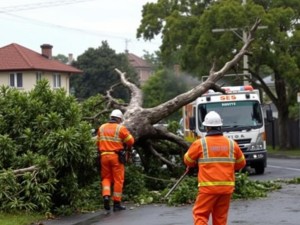
unplanned cutting.
Under the Trees Act, an owner of affected land may apply to the NSW Land and Environment Court
for orders to remedy, restrain or prevent property damage, or to prevent injury caused by a tree
on adjoining land.
The Court does not grant every application merely because leaves fall, gutters need cleaning or a
tree causes inconvenience. Each matter is assessed on its evidence and circumstances. A clear
arborist report for a tree dispute can help explain the condition of the tree, likely failure
points and the work reasonably required.
powerlines. Keep away from the area and contact the relevant utility or emergency service where
immediate danger exists.
For storm-damaged tree branches or an imminent risk of branch failure, see
emergency tree lopping services available in Sydney
.
What if it is a council tree overhanging my property in NSW?
Do not treat a street tree or council-owned tree as though it belongs to a private neighbour.
Report the issue to the relevant council and provide clear photos, the tree’s location and an
explanation of the hazard or damage.
Councils may inspect the tree and decide whether pruning is needed. Cutting a street tree yourself
can breach council controls. This is especially important where branches are above a public road,
footpath, service line or council reserve.
What should I do about my neighbour’s overhanging tree branches?
- Photograph the problem.
Take wide and close photographs from your property. Record cracks, dead branches, roof contact,
fence damage or blocked access. - Check the property boundary.
Do not assume the fence is placed exactly on the legal boundary. Obtain professional advice
where the location is disputed. - Speak with your neighbour.
Explain the concern calmly. A shared inspection and agreed pruning plan is usually faster and
less stressful than a neighbour tree dispute. - Send a written request.
Summarise the issue, attach photographs and keep the tone practical. Keep a copy of the notice
to your neighbour. - Check council tree rules.
Confirm whether a tree preservation order, protected-tree rule, heritage control or pruning
permit applies. - Obtain an arborist assessment.
For a large limb, possible decay, roof damage or safety concern, arrange a tree risk assessment
before authorising work. - Use mediation where appropriate.
Neighbour mediation in NSW can help both owners agree on access, the pruning scope, waste
removal and responsibility for costs. - Consider legal advice or a court application.
Where serious damage or injury risk remains unresolved, ask about the Trees Act and the NSW
Land and Environment Court tree-dispute process.
Interactive overhanging-branch risk check
Tick every statement that applies. This tool gives general next-step guidance and is not a
legal or arboricultural diagnosis.
How Triple T Tree Services can help with boundary tree pruning
Triple T Tree Services assists homeowners across North Shore Sydney and surrounding Sydney areas
with overhanging branch removal, tree hazard assessment, council-aware pruning and controlled
tree lopping.
The first goal is not to remove the largest possible amount of canopy. It is to identify a safe,
lawful and practical outcome. Depending on the tree, that may involve selective pruning, crown
reduction, deadwood removal, clearance from a roof or a documented emergency make-safe.
The team can assess access, branch weight, targets below the canopy, visible defects and whether
the proposed work may conflict with local tree-preservation rules. Where a dispute is already
developing, a clear scope of work can also help neighbours understand what will be cut and what
will remain.
Learn more about Triple T Tree Services’ experience and approach through the
Tree Lopping Service Sydney information page
.
Need an assessment on the North Shore?
Call Triple T Tree Services on
+61 430 585 379.
Explain where the branch is located, whether it is damaged and what sits below it. Photos can
help the team understand the access and likely equipment requirements.
An illustrative North Shore neighbour-tree scenario
Consider a typical North Shore home with a mature tree growing next door. One long branch crosses
the fence and rests above a tiled roof. Leaves are annoying, but the real concern is a visible
split near the branch union.
Cutting the branch at the fence with a pole saw could leave a heavy unsupported section and tear
the bark. Entering the neighbour’s yard without consent would create another problem. The safer
route is to photograph the split, speak with the neighbour, confirm council controls and arrange
an arborist inspection.
The inspection may show that a smaller, staged reduction is enough. It may also show that a proper
cut must be made on the neighbour’s side. In that case, both owners can agree on access and the
scope before work starts. This approach protects the roof, the tree and the relationship.
This is an illustrative example, not a claim about a specific customer or court matter.
Frequently asked questions about overhanging tree branches NSW law
Can my neighbour stop me cutting overhanging branches?
Your neighbour may object if the proposed work goes beyond the boundary, requires access to
their property, may damage the tree or breaches council controls. Speak with them and check the
council rules before work begins.
Do I need permission to trim my neighbour’s tree?
You should obtain the neighbour’s permission for access to their land or for cuts that must be
made on their side. Council permission may also be required for a protected tree.
How far can I cut back my neighbour’s tree?
The usual starting point is no farther than the property boundary. However, the correct pruning
cut may not be located at the fence. Large or structural limbs should be assessed by an
arborist.
Can I enter my neighbour’s property to prune the tree?
Not without permission or another lawful authority. Entering adjoining land without consent
may amount to trespass.
Who pays to remove overhanging branches in NSW?
For ordinary encroaching growth, the affected property owner may often arrange and pay for
pruning from their side. Damage claims, prior warnings, negligence issues and court orders can
affect responsibility.
What happens if my neighbour’s tree damages my property?
Photograph the damage, notify the neighbour in writing, contact your insurer where relevant and
obtain expert advice. The Trees Act may provide a pathway for orders or compensation in suitable
cases.
Can the council make my neighbour prune the tree?
A council may act where its own laws, safety responsibilities or planning controls apply, but
ordinary private tree disputes are not automatically resolved by the council. Ask the council
what role it can legally take.
What are the new rules on planting trees on boundaries in NSW?
There is no single simple statewide planting rule that replaces local planning, vegetation and
neighbour-dispute laws. Setbacks and species controls may depend on the council, development
consent, easements and site conditions.
Who has fallen-tree removal responsibility in NSW?
Responsibility depends on where the tree fell, why it failed, whether reasonable warning signs
existed, property ownership and insurance terms. Make the area safe, document the scene and
obtain legal or insurance advice before accepting liability.
Related tree lopping and pruning guides
Evidence, accuracy and legal sources
This guide was checked against NSW legal information available in 2026. It does not replace
advice about your individual property, council area or dispute.