

Can NSW Homeowners Cut Back a Tree Without Getting Approval First?
Sometimes—but a homeowner should never assume that Lopping Tree
branches is automatically allowed. NSW councils set local tree pruning rules,
and approval can depend on the tree’s size, species, location, health and the
amount you plan to remove.
NSW homeowners may cut back a tree without approval only when the work
clearly falls within an exemption that applies to their property and
local council area. If you cannot confirm the exemption in writing,
pause the work and check with the council or a qualified arborist.
This is important because there is no single rule that lets every NSW
homeowner remove a fixed percentage of a tree. A minor cut in one council
area may need a tree-pruning application in another.
The safest rule is simple: identify the tree, find the property’s local
government area, read the current tree-management policy and confirm
whether the planned branch removal is exempt. Do this before a saw,
pole pruner or chainsaw touches the tree.
This article has been prepared using current NSW Government, planning
and Sydney council guidance. Practical tree-work context is supported by
the experience described in the
Triple T Tree Services tree lopping Sydney profile
.
Council requirements can change, so the relevant council remains the
final authority for a specific property.
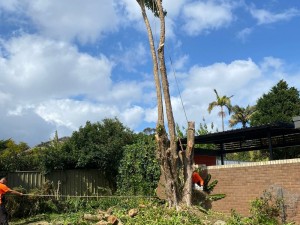
When may lopping a tree be allowed without approval?
Some local policies allow limited pruning without a permit. However,
the exact wording matters. An exemption may set limits on branch size,
canopy loss, clearance distance, pruning method or the qualifications
of the person doing the work.
Small, routine maintenance cuts
Light residential tree pruning may be exempt when it removes small
dead branches or provides permitted clearance without harming the
tree’s natural form.
Listed exempt species
Some councils publish species that can be pruned or removed without
a standard tree removal permit. The list must be checked for the
correct council and current policy version.
Dead or immediately dangerous trees
Emergency tree pruning or dangerous tree removal may have a special
pathway. Do not assume a dead tree is automatically exempt. Photos,
an arborist assessment or written council confirmation may be needed.
Eligible 10/50 clearing
Certain properties in mapped bushfire areas may qualify for vegetation
clearing under the NSW 10/50 scheme. The address, vegetation and
clearing method must meet the scheme’s rules.
Their property may sit in another council area, heritage zone, mapped
habitat area or bushfire entitlement area. Even two homes on nearby
streets can face different controls.
When is council approval for tree pruning likely to be required?
Stop and investigate before cutting when one or more of the following
conditions apply:
- The tree appears on a significant tree register.
- The property is heritage listed or in a heritage conservation area.
- The tree is a protected native species or provides wildlife habitat.
- You plan to remove major limbs or a large part of the canopy.
- The work could change the tree’s natural shape or long-term health.
- The tree stands on a boundary or belongs to a neighbour.
- The branches are close to public powerlines or a street.
- The tree is connected to a development consent or landscape plan.
- The property is affected by biodiversity or protected vegetation controls.
These situations may call for a council tree inspection, a tree-cutting
permit, heritage-listed tree approval, an arborist report or a development
application. Starting first and asking later can expose the homeowner to
tree damage penalties and rectification orders.
Can I cut down a gum tree on my property?
Owning the land does not automatically give permission to cut down a gum
tree. Eucalypts and other native trees may be protected by local council
controls, biodiversity rules, heritage provisions or development consent
conditions.
A large gum can also carry heavy limbs above roofs, vehicles and fences.
Even where removal is permitted, this is not a safe do-it-yourself job.
Controlled rigging may be needed to lower each section without damaging
the home or neighbouring property.
Why do Sydney tree lopping rules change between suburbs?
NSW planning rules allow councils to manage vegetation through local
permit systems and tree-management controls. This means questions such as
“What trees can be cut down without permission in NSW?” cannot be answered
with one statewide species list.
City of Sydney
Certain limited pruning can be exempt when it follows the council’s
stated clearance and pruning conditions. Protected, heritage or
non-exempt work still needs the correct approval pathway.
North Sydney and North Shore
Protected trees require an application under the relevant tree and
vegetation controls. Access from a neighbour’s property can also
affect who must submit the application.
Northern Beaches
A high-risk tree may follow a specific exemption process, but written
confirmation from an appropriately qualified arborist can be required.
Ku-ring-gai
A dead tree is not automatically free to remove. Written confirmation
may be required so the council can consider habitat and other controls.
The same care is needed for a Parramatta Council tree removal application,
Tree Lopping Sydney CBD, work in the North Shore and tree maintenance in
Western Sydney. Always use the policy for the property’s exact local
government area.
Who is responsible for trimming overhanging trees in NSW?
The tree usually belongs to the person whose land contains the trunk.
A neighbour may have a limited right to address branches or roots that
cross the boundary, but that does not cancel council tree regulations.
Before pruning a neighbour’s tree in NSW:
- Confirm the legal boundary.
- Speak with the tree owner.
- Check whether the tree is protected.
- Confirm whether council approval is needed.
- Do not enter the neighbouring property without permission.
- Do not cut beyond the boundary or destabilise the tree.
Practical Sydney example
Imagine a mature branch extending over a North Shore roof. Cutting the
branch flush at the trunk may require access to the neighbour’s land and
may remove too much weight from one side of the canopy. A better solution
may be a selective reduction cut made from the tree owner’s side, subject
to council rules and safe access.
This is why a professional tree lopper should assess the whole tree—not
only the branch visible above the gutter.
Interactive tree pruning approval check
This quick tool does not replace council advice. It helps identify
common reasons to stop and investigate.
A safer six-step process before cutting a tree
1. Identify the council
Use the property address to confirm the local government area. Do not
rely only on the suburb name.
2. Identify the tree
Record the species if known, estimated height, trunk size, condition and
distance from buildings or boundaries. Take clear photos from several angles.
3. Define the work
“Cut it back” is too vague. State which branches need removal, why the work
is needed and how much canopy could be affected.
4. Read the current council policy
Look for protected-tree definitions, exempt species, pruning exemptions,
heritage controls and application requirements.
5. Obtain written confirmation
Keep the permit, exemption confirmation, arborist report, photographs and
any neighbour access agreement with the job records.
6. Use a safe pruning method
Good pruning removes selected branches while protecting the branch collar
and maintaining a balanced canopy. Aggressive topping can create large
wounds and fast, weak regrowth.
For a clearer explanation, read
the difference between tree lopping, pruning and trimming in Sydney
.
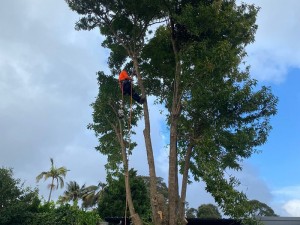
How Triple T Tree Services can help before you cut
Triple T Tree Services helps Sydney and North Shore homeowners understand
the work needed before branches are removed. The team can inspect the tree,
consider access and nearby hazards, explain whether pruning or removal may
be more suitable, and help homeowners prepare the information required for
council enquiries.
Tree and site assessment
The tree’s condition, branch weight, species, structures below and
safe working area can be reviewed before the scope is confirmed.
Council-aware planning
The proposed work can be matched to the applicable local council
tree-management policy instead of relying on a general NSW assumption.
Selective pruning
Where possible, problem branches can be reduced while preserving tree
health, natural form, shade and privacy.
Urgent make-safe work
Storm-damaged or hanging branches can be assessed through an appropriate
emergency process, with photographs and records kept where practical.
Homeowners can explore
professional tree lopping services in Sydney
or call 0430 585 379 for advice about
the tree and site. A specific tree lopping price should be based on an
inspection or clear photographs because tree size, access, rigging,
council requirements and nearby structures all affect the job.
Official sources homeowners should check
- Service NSW guidance on removing trees from private property.
- NSW Planning guidance on vegetation management in non-rural areas.
- The relevant council’s current tree-management policy and application page.
- NSW Rural Fire Service mapping and conditions for the 10/50 scheme.
- Heritage and development consent records affecting the property.
This article provides general information, not legal advice or council
approval. Confirm the rules for the exact address before work starts.
Related tree lopping guides
Frequently asked questions
Possibly, but you must first check your local council tree pruning
rules. The species, size, heritage status, location and amount of
pruning can determine whether approval is required.
There is no single NSW-wide answer. Some councils list exempt species
or size thresholds, while other planning, heritage or biodiversity
controls may still apply.
It may be, but not in every council area or situation. Some councils
require evidence that a branch is dead or that the tree presents an
immediate risk. Habitat value may also need consideration.
Do not attempt this yourself. Tree pruning near powerlines carries
serious electrical and fall risks and may involve the electricity
network operator or specially authorised workers.
A council may investigate, request evidence, issue orders or begin
enforcement action. The outcome depends on the law, council policy,
extent of damage and circumstances of the work.
Tree lopping prices depend on the tree’s size, access, branch weight,
nearby structures, rigging needs, waste handling and council
requirements. For a specific quote, call Triple T Tree Services on
0430 585 379.